
Objective:
To ensure that assets are carried at no more than their recoverable amount, and to define how recoverable amount is calculated.
IAS 36 applies to (among other assets):
land
buildings
machinery and equipment
investment property carried at cost
intangible assets
goodwill
investments in subsidiaries, associates, and joint ventures
assets carried at revalued amounts under IAS 16 and IAS 38
IAS 36 does not apply to the following assets:
investment property carried at fair value (IAS 40)
inventories (IAS 02)
assets held for sale (IFRS 5)
deferred tax assets (IAS 12)
financial assets (IAS 39)
certain agricultural assets carried at fair value (IAS 41
- Identify possible impairment indicators (external vs. internal)
- Perform impairment review (if identified possible impairments)
- Record the impairment
1. Indicators of Impairment
External sources
- A significant decline in the asset’s market value more than expected by normal use or passage of time
- A significant adverse change in the technological, economic or legal environment
Internal sources
- Obsolescence or physical damage
- Significant changes, in the period or expected, in the way the asset is being used e.g. asset becoming idle, plans for early disposal or discontinuing/ restructuring the operation where the asset is used
- Evidence that asset’s economic performance will be worse than expected
- Operating losses or net cash outflows for the asset
- Loss of key employee
2. Impairment review
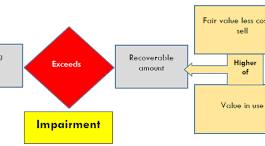
If the carrying value of the asset is greater than its recoverable amount, it is impaired and should be written down to its recoverable amount.
- Recoverable amount – the greater of fair value less cost to sell and value in use.
- Fair value less costs to sell – the amount receivable from the sale of the asset less the costs of disposal.
- Value in use – the present value of the future cash flows from the asset.