
Deferred tax is accounted for in accordance with IAS 12 Income Taxes. In FR, deferred tax normally results in a liability being recognized within the statement of financial position. IAS 12 defines a deferred tax liability as being the amount of income tax payable in future periods in respect of taxable temporary differences. So, in simple terms, deferred tax is tax that is payable in the future. However, to understand this definition more fully, it is necessary to explain the term ‘taxable temporary differences.
Temporary differences are defined as being differences between the carrying amount of an asset (or liability) within the statement of financial position and its tax base ie the amount at which the asset (or liability) is valued for tax purposes by the relevant tax authority.
Taxable temporary differences are those on which tax will be charged in the future when the asset (or liability) is recovered (or settled).
IAS 12 requires that a deferred tax liability is recorded in respect of all taxable temporary differences that exist at the year-end – this is sometimes known as the full provision method.
All of this terminology can be rather overwhelming and difficult to understand, so consider it alongside an example. Depreciable non-current assets are the typical deferred tax example used in FR.
Within financial statements, non-current assets with a limited useful life are subject to depreciation. However, within tax computations, non-current assets are subject to capital allowances (also known as tax depreciation) at rates set within the relevant tax legislation. Where at the year-end the cumulative depreciation charged and the cumulative capital allowances claimed are different, the carrying amount of the asset (cost less accumulated depreciation) will then be different to its tax base (cost less accumulated capital allowances) and hence a taxable temporary difference arises.
The closing figures are reported in the statement of financial position as part of the deferred tax liability.
The statement of profit or loss
As IAS 12 considers deferred tax from the perspective of temporary differences between the carrying amount and tax base of assets and liabilities, the standard can be said to take a ‘balance sheet approach’. However, it will be helpful to consider the effect on the statement of profit or loss.
The income tax liability is then recorded as an income tax expense. As we have seen in the example, accounting for deferred tax then results in a further increase or decrease in the income tax expense. Therefore, the final income tax expense for each year reported in the statement of profit or loss would be as in Table 3.
It can therefore be said that accounting for deferred tax is ensuring that the matching principle is applied. The tax expense reported in each period is the tax consequences (ie tax charges less tax relief) of the items reported within profit in that period.
Situations 1 and 2 are both giving a figure that can be slotted straight into the deferred tax working. In situations 3 and 4 however, the temporary differences are being given. These are then used to calculate a figure which can be slotted into the working. In all situations, the missing figure is calculated as a balancing figure. Table 4 shows the completed workings.
Revaluations of non-current assets
Revaluations of non-current assets (NCA) are a further example of a taxable temporary difference. When an NCA is revalued to its current value within the financial statements, the revaluation surplus is recorded in other comprehensive income (OCI). While the carrying amount of the asset has increased, the tax base of the asset remains the same and so a temporary difference arises.
Deferred tax arises in respect of many different types of asset or liability and not just non-current assets as discussed above. Therefore, for SBR it is more important that candidates understand the principles behind deferred tax so that they can be applied to any given situation. Some of the situations that may be seen are discussed below. In all the following situations, assume that the applicable tax rate is 25%.
Deferred tax assets
It is important to be aware that temporary differences can result in needing to record a deferred tax asset instead of a liability. Temporary differences affect the timing of when tax is paid or when tax relief is received. While normally they result in the payment being deferred until the future or relief being received in advance (and hence a deferred tax liability) they can result in the payment being accelerated or relief being due in the future.
In these latter situations the temporary differences result in a deferred tax asset arising (or where the entity has other larger temporary differences that create deferred tax liabilities, a reduced deferred tax liability).
Whether an individual temporary difference gives rise to a deferred tax asset or liability can be ascertained by applying the following rule:
| Carrying amount of asset / (Liability) | Tax base of asset / (Liability) | = | Temporary difference |
If the temporary difference is positive, a deferred tax liability will arise. If the temporary difference is negative, a deferred tax asset will arise.
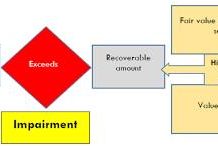
receive tax relief on the impairment loss in the future when the asset is sold.
The deferred tax asset at the reporting date will be 25% x $700 = $175.
It is worth noting here that revaluation gains, which increase the carrying amount of the asset and leave the tax base unchanged, result in a deferred tax liability. Conversely, impairment losses, which decrease the carrying amount of the asset and leave the tax base unchanged, result in a deferred tax asset.
.
Fair value adjustments
At the date of acquisition, a subsidiary’s identifiable net assets are measured at fair value. The fair value adjustments may not alter the tax base of the net assets and hence a temporary difference may arise. Any deferred tax asset/liability arising as a result is included within the fair value of the subsidiary’s net assets at acquisition for the purposes of calculating goodwill.
Goodwill
Goodwill which arises on the acquisition of a subsidiary is only recognised in the consolidated financial statements; it is not recognised in the individual financial statements. Theoretically, goodwill gives rise to a temporary difference that would result in a deferred tax liability as it is an asset with a carrying amount within the consolidated financial statements but will have a nil tax base. However, IAS 12 specifically excludes a deferred tax liability being recognised in respect of goodwill.
Provisions for unrealised profits (PUPs)
When goods are sold between group companies and remain in the inventory of the buying company at the year-end, an adjustment is made to remove the unrealised profit from the consolidated financial statements. This adjustment also reduces the inventory to the original cost when a group company first purchased it. However, the tax base of the inventory will be based on individual financial statements and so will be at the higher transfer price. Consequently, a deferred tax asset will arise. Recognition of the asset and the consequent decrease in the tax expense will ensure that the tax already charged to the individual selling company is not reflected in the current year’s consolidated statement of profit or loss but will be matched against the future period when the profit is recognised by the group.
.
Measurement of deferred tax
IAS 12 states that deferred tax assets and liabilities should be measured based on the tax rates that are expected to apply when the asset/liability will be realised/settled. Normally, current tax rates are used to calculate deferred tax on the basis that they are a reasonable approximation of future tax rates and that it would be too unreliable to estimate future tax rates.
Deferred tax assets and liabilities represent future taxes that will be recovered or that will be payable. It may therefore be expected that they should be discounted to reflect the time value of money, which would be consistent with the way in which other liabilities are measured. IAS 12, however, does not permit or allow the discounting of deferred tax assets or liabilities on practical grounds.
The primary reason behind this is that it would be necessary for entities to determine when the future tax would be recovered or paid. In practice this is highly complex and subjective. Therefore, to require discounting of deferred tax liabilities would result in a high degree of unreliability. Furthermore, to allow but not require discounting would result in inconsistency and so a lack of comparability between entities.
Deferred tax and the Conceptual Framework
As we have seen, IAS 12 considers deferred tax by taking a ‘balance sheet’ approach to the accounting problem by considering temporary differences in terms of the difference between the carrying amounts and the tax values of assets and liabilities – also known as the valuation approach. This can be said to be consistent with the approach taken to recognition in the International Accounting Standards Board’s Conceptual Framework for Financial Reporting (the Conceptual Framework). However, the valuation approach is applied regardless of whether the resulting deferred tax will meet the definition of an asset or liability in its own right.
Thus, IAS 12 considers the overriding accounting issue behind deferred tax to be the application of matching – ensuring that the tax consequences of an item reported within the financial statements are reported in the same accounting period as the item itself.
For example, in the case of a revaluation, since the gain has been recognised in the financial statements, the tax consequences of this gain should also be recognised – that is to say, a tax charge. In order to recognise a tax charge, it is necessary to complete the double entry by also recording a corresponding deferred tax liability.
However, part of the Conceptual Framework’s definition of a liability is that there is a ‘present obligation’. Therefore, the deferred tax liability arising on the revaluation gain should represent the current obligation to pay tax in the future when the asset is sold. However, since there is no present obligation to sell the asset, there is no present obligation to pay the tax.
Therefore, it is also acknowledged that IAS 12 is inconsistent with the Conceptual Framework to the extent that a deferred tax asset or liability does not necessarily meet the definition of an asset or liability